I remember my father
telling Tim and me
About the mountains and the train
And the excitement of going on a trip.
What do I remember of the evacuation?
I remember my mother wrapping
A blanket around me and my
Pretending to fall asleep so she would be happy
Although I was so excited I couldn't sleep
(I hear there were people herded
Into the Hastings Park like cattle.
Families were made to move in two hours
Abandoning everything, leaving pets
And possessions at gun point.
I hear families were broken up
Men were forced to work. I heard
It whispered late at night
That there was suffering) and
I missed my dolls.
What do I remember of the evacuation?
I remember Miss Foster and Miss Tucker
Who still live in Vancouver
And who did what they could
And loved the children and who gave me
A puzzle to play with on the train.
And I remember the mountains and I was
Six years old and I swear I saw a giant
Gulliver of Gulliver's Travels scanning the horizon
And when I told my mother she believed it too
And I remember how careful my parents were
Not to bruise us with bitterness
And I remember the puzzle of Lorraine Life
Who said "Don't insult me" when I
Proudly wrote my name in Japanese
And Tim flew the Union Jack
When the war was over but Lorraine
And her friends spat on us anyway
and I prayed to the God who loves
All the children in his sight
That I might be white.
Copyright © 1985 Joy Kogawa. All rights reserved.
About the mountains and the train
And the excitement of going on a trip.
What do I remember of the evacuation?
I remember my mother wrapping
A blanket around me and my
Pretending to fall asleep so she would be happy
Although I was so excited I couldn't sleep
(I hear there were people herded
Into the Hastings Park like cattle.
Families were made to move in two hours
Abandoning everything, leaving pets
And possessions at gun point.
I hear families were broken up
Men were forced to work. I heard
It whispered late at night
That there was suffering) and
I missed my dolls.
What do I remember of the evacuation?
I remember Miss Foster and Miss Tucker
Who still live in Vancouver
And who did what they could
And loved the children and who gave me
A puzzle to play with on the train.
And I remember the mountains and I was
Six years old and I swear I saw a giant
Gulliver of Gulliver's Travels scanning the horizon
And when I told my mother she believed it too
And I remember how careful my parents were
Not to bruise us with bitterness
And I remember the puzzle of Lorraine Life
Who said "Don't insult me" when I
Proudly wrote my name in Japanese
And Tim flew the Union Jack
When the war was over but Lorraine
And her friends spat on us anyway
and I prayed to the God who loves
All the children in his sight
That I might be white.
Copyright © 1985 Joy Kogawa. All rights reserved.

Waiting to be sent
to an internment camp inland
in British Columbia
(source)
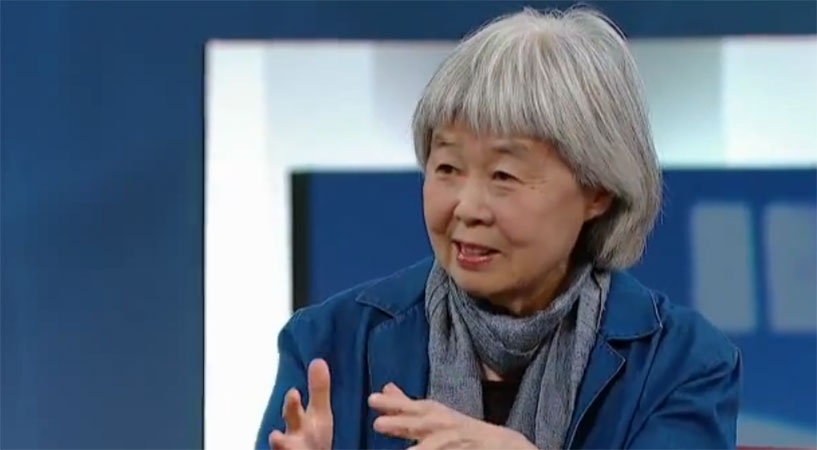
Joy Kogawa / CBC photo
Oh, the heartbreaking last line of that poem! I wish that no child ever had to feel that way! Joy Kogawa, born in 1935 in Vancouver, B.C., is a beloved Canadian writer. She is better known for her fiction than her poetry, but her story is so remarkable, as told in the poem above, that I wanted to share her with you.
Ms Kogawa was published first as a poet. But the work that launched her career is her first novel, Obasan, the story of a seven year old Japanese-Canadian girl who was sent with her family to an internment camp during World War II, the work closely mirroring her own experience. Obasan has been declared one of the most important books in Canadian history by the Literary Review of Canada. It was adapted into a children's book, Naomi's Road, and an opera, which toured B.C. schools in 1986.
Obasan was followed by Itsuka, reflecting Ms Kogawa's real life activism in seeking redress for Japanese Canadians; The Rain Ascends, tackling the thorny subject of sexual abuse of children; and her most recent work, the long-awaited memoir of her spiritual pilgrimage, Gently to Nagasaki.
Of interest is the story of her childhood home in Vancouver, that was stripped from her family by the government when the family was interned. All property, businesses and assets of Japanese Canadians were confiscated, "to cover the costs of their internment".
In 2005, Ms Kogawa learned the house was for sale, and was going to be demolished. The Save Kogawa House Society was formed to purchase it just in time. It now operates as a cultural treasure, preserving Ms Kogawa's story, and educating today's children about the events of yesterday, so that dismal chapter of our history is never forgotten.
I had the privilege of staying in that house when my friend, the author Christine Lowther, was there as writer-in-residence two years ago. I was awed to sleep in the author's childhood bed. The cherry tree she wrote of in Obasan is still there, outside her bedroom window. Here is a peek at the house:
In a tv interview, when asked about the amazing journey that began with her most-loved work, Obasan, Ms. Kogawa said it has been "miraculous."

Of writing, she has said, "Poetry is a kind of gasp, and there it is, a spark on the page. Fiction, on the other hand, is swamp fire." I so adore that description!
Joy Kogawa is a member of the Order of Canada and the Order of B.C.
Her website is at joykagawa.ca.
She is a beautiful writer, and person, of gentle heart, and I can't recommend her work highly enough.
Material shared in 'I Wish I'd Written This' is presented for study and review. Poems, photos and other writings remain the property of the copyright owners, usually their authors

