“A poem begins as a lump in the throat, a sense of wrong, a homesickness, a lovesickness.”
―
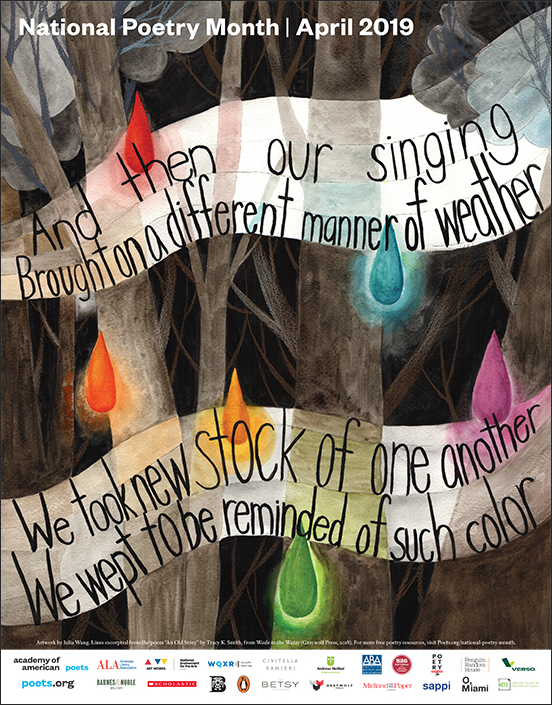 |
Art by tenth grader Julia Wang from San Jose, California, who has won the inaugural National Poetry Month Poster Contest. Wang’s artwork was selected by contest judges Naomi Shihab Nye and Debbie Millman . . . . It incorporates lines from the poem "An Old Story" by current U. S. Poet Laureate Tracy K. Smith.
Read more about Wang’s winning artwork.
Read more about Wang’s winning artwork.
“Poetry is finer and more philosophical than history; for poetry expresses the universal, and history only the particular.”
―
"Poetry is the spontaneous overflow of powerful feelings: it takes its origin from emotion recollected in tranquility."
--William Wordsworth |
Midweek Motif ~ Writing Poetry
Writing Poetry is what we do. Why?
According to Jane Hirshfeld:
"One reason to write a poem is to flush from the deep thickets of the self some thought, feeling, comprehension, question, music, you didn’t know was in you, or in the world. Other forms of writing—scientific papers, political analysis, most journalism—attempt to capture and comprehend something known. Poetry is a release of something previously unknown into the visible. You write to invite that, to make of yourself a gathering of the unexpected and, with luck, of the unexpectable." (Read the rest HERE.)
Is she right? What is a poem?
Your Challenge: In a New poem, tell us Why Write Poetry? and/or What Is Poetry? Consider limiting yourself to addressing one poem rather than generalizing.
🟍
Last Monday, Sherry gave us Poems of the Week ~ Three Poets on Poetry
in which Sanaa, Rajani and Sumana answered that question. Below I
provide a few excerpts of the feature:
In POEM HOLDING ITS HEART IN ONE FIST*, Sanaa notes:
". . . sometimes it’s better to counsel with our hearts alone.
I have found that pink buds are perfect within
and destined to open. . . . "
In THE POET HAS GONE, Sumana notes:
". . . Things of beauty,
Scattered everywhere
Like a Mary Oliver page-
Yet there’s an uncanny calm . . . ."
Scattered everywhere
Like a Mary Oliver page-
Yet there’s an uncanny calm . . . ."
And in JUST MATH, Rajani notes:
"Even Rumi, who could fit the entire
universe inside his poem, was yearning
for the grace of the Beloved. The universe
is not enough. . . ."
universe inside his poem, was yearning
for the grace of the Beloved. The universe
is not enough. . . ."
At the podium
measured and grave as a metronome
the (white, male) poet with bald-
gleaming head broods in gnom-
ic syllables on the death
of 12-year-old (black, male) Tamir Rice
shot in a park
by a Cleveland police officer
claiming to believe
the boy’s plastic pistol
was a “real gun”
like his own eager
to discharge and slay
while twelve feet away
at the edge
of the bright-lit stage
the (white, female) interpreter
signing for the deaf is stricken
with emotion —
horror, pity, disbelief —
outrage, sorrow —
young-woman face contorted
and eyes spilling tears
like Tamir Rice’s mother
perhaps, or the sister
made to witness
the child’s bleeding out
in the Cleveland park.
We stare
as the interpreter’s fingers
pluck the poet’s words out of the air
like bullets, break open stanzas
tight as conches with the deft
ferocity of a cormo-
rant and render gnome-speech
raw as hurt, as harm,
as human terror
wet-eyed and mouth-grimaced
in horror’s perfect O.
 |
| The Parnassus: The whole room shows the four areas of human knowledge: philosophy, religion, poetry and law, with The Parnassus representing poetry. by Rafael (1511)
Morn on her rosy couch awoke,
Enchantment led the hour,
And mirth and music drank the dews
That freshen’d Beauty’s flower,
Then from her bower of deep delight,
I heard a young girl sing,
‘Oh, speak no ill of poetry,
For ’tis a holy thing.’
The Sun in noon-day heat rose high,
And on the heaving breast,
I saw a weary pilgrim toil
Unpitied and unblest,
Yet still in trembling measures flow’d
Forth from a broken string,
‘Oh, speak no ill of poetry,
For ’tis a holy thing.’
’Twas night, and Death the curtains drew,
’Mid agony severe,
While there a willing spirit went
Home to a glorious sphere,
Yet still it sigh’d, even when was spread
The waiting Angel’s wing,
‘Oh, speak no ill of poetry,
For ’tis a holy thing.’
by Matt Haig
I
Like
The Way
That when you
Tilt
Poems
On their side
They
Look like
Miniature
Cities
From
A long way
Away.
Skyscrapers
Made out
Of
Words.
Please share your new poem
using Mr. Linky below and visit others in the spirit of the community—
(Next week Sumana’s Midweek Motif
will be ~ Temptation) |


